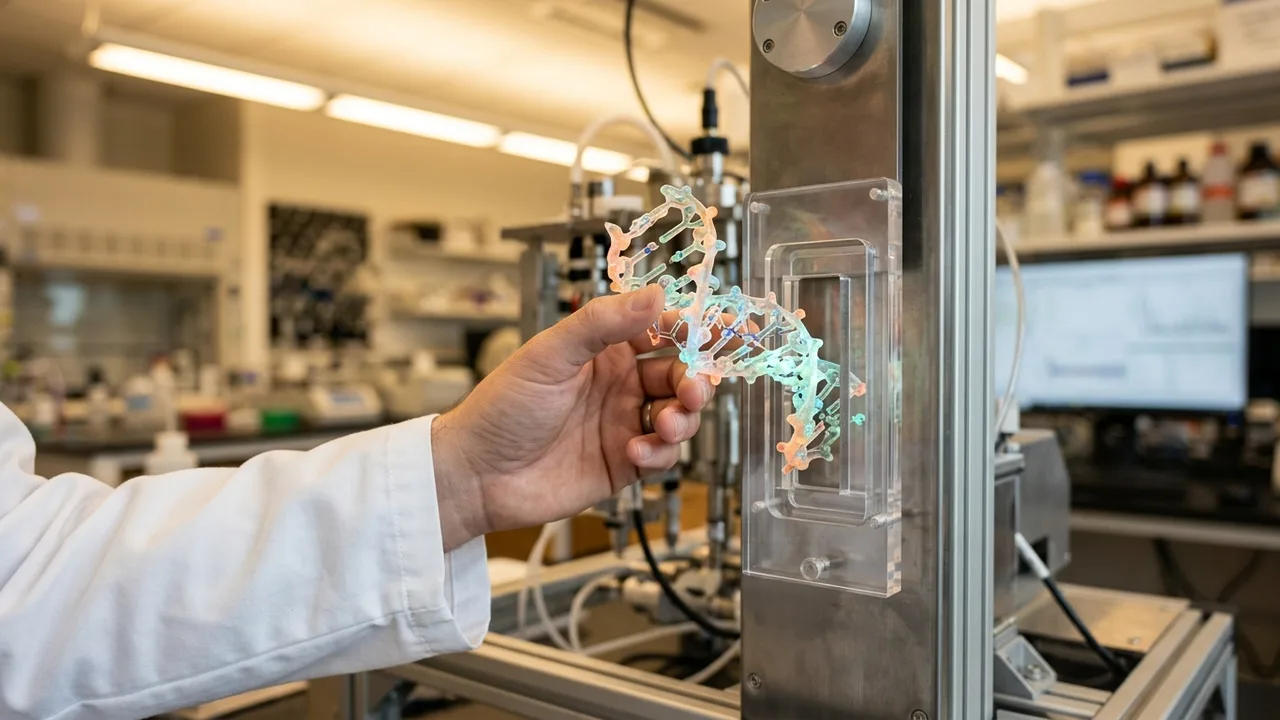
The development of new drugs and treatments is a lengthy process. But NVIDIA, known for its powerful graphics chips, has now introduced a tool that fundamentally changes this area: the BioNeMo Agent Toolkit. It promises to extremely accelerate AI in life sciences, thus advancing research.
This update is not a small feature, but a **real power shift** in pharmaceutical research. Those who use the BioNeMo Agent Toolkit can drastically shorten development times and save costs. Those who hesitate will lose valuable time in the **global innovation race** and risk being left behind by the competition. This is about multi-billion dollar markets and the future of our health.
NVIDIA has released its BioNeMo Agent Toolkit. This tool allows researchers in life sciences to develop so-called **AI agents**. These agents can independently solve complex tasks and use various software tools. The goal is to massively accelerate **drug development** and other areas of biology. For example, it works with the **AI model Claude Science**.
For you as a normal consumer, this development means that new **drugs could come to market faster**. Diseases for which there is currently no good treatment could be combated more effectively in the future thanks to accelerated AI research. However, there is also concern that the speed of AI may not always optimally accompany **safety checks**.
Companies in the pharmaceutical and life sciences industry are at a **turning point**. The BioNeMo Agent Toolkit enables the **automation** of research processes and the reduction of **R&D costs** (Research and Development). Those who do not invest in this technology now and train their teams will have a **clear disadvantage** compared to AI-driven competitors. There is a risk of 'lock-in' to outdated, slower methods.
The biggest opportunity lies in the **drastic acceleration** of research and development. AI agents can take over routine tasks that previously took a lot of time. This allows researchers to focus on **complex problems**. The toolkit also makes it possible to find new molecular structures or predict the effects of drugs more precisely. It's like a **turbo boost** for the entire industry.
A major risk is **loss of control**. If AI agents work more and more autonomously, it becomes more difficult to understand their decisions. This is particularly critical in drug development, where **errors can have serious consequences**. In addition, there is enormous **pressure on smaller companies** that may not be able to afford NVIDIA's expensive AI infrastructure and thus fall behind.